Views: 0 Author: Site Editor Publish Time: 2026-10-15 Origin: Site


For utility-scale solar developers and EPCs, selecting the right tracker architecture directly dictates project LCOE. It heavily influences upfront CapEx through steel requirements and piling volume. It also drives long-term OpEx by dictating maintenance routines and energy yield optimization. Yet, choosing between 1-in-Portrait (1P) and 2-in-Portrait (2P) configurations rarely presents a simple choice. Project teams must carefully balance site-specific wind loads against complex geotechnical realities. You also need to factor in evolving module formats alongside strict land constraints. Making the wrong choice can compromise energy generation or heavily inflate construction budgets. We built this guide to deconstruct the engineering, installation, and operational trade-offs between 1P and 2P formats. You will uncover practical insights into wind mitigation, foundation planning, and cleaning logistics. Our analysis supports data-driven procurement decisions, ensuring your next solar farm maximizes structural integrity and operational efficiency.
**Structural Mechanics:** 1P systems offer a lower center of gravity and superior inherent aerodynamic stability, while 2P systems maximize module density but require aggressive wind mitigation (dampeners, thicker steel).
**Foundation Costs:** 2P configurations significantly reduce pile counts (often by 30–40%), making them highly viable for rocky or hard-soil sites where foundation work drives up CapEx.
**O&M Realities:** 1P trackers allow for easier ground-level access and robotic cleaning. 2P systems complicate module washing due to height but reduce the total number of drive motors and controllers to maintain.
**Terrain Adaptability:** 1P adapts better to undulating topography with minimal grading; 2P typically requires flatter terrain to prevent shading and structural misalignment.
Understanding the fundamental geometry of tracker structures is critical before assessing their economic impacts. The layout dictates how the entire system reacts to environmental stressors.
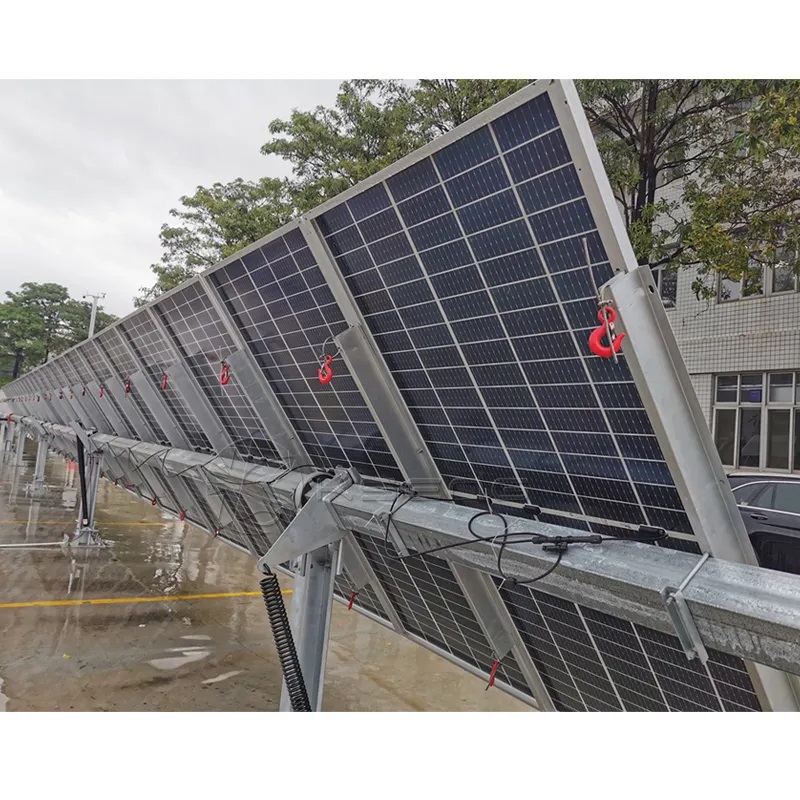
1-in-Portrait (1P): In this configuration, modules mount in a single vertical row along the central torque tube. The system maintains a low profile close to the ground. Developers typically deploy longer row lengths to achieve the desired wattage per drive motor. This keeps the center of gravity low and distributes weight evenly.
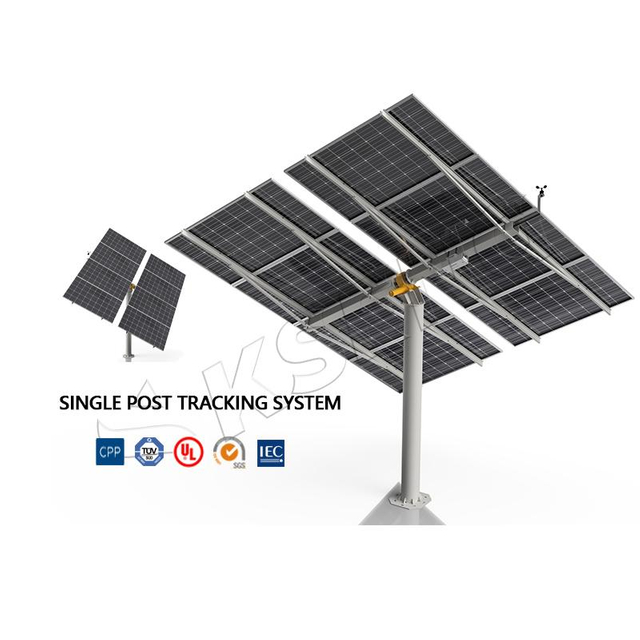
2-in-Portrait (2P): Here, modules stack two-high vertically along the torque tube. The structure demands high ground clearance to accommodate the rotation of a wider panel array. Teams build shorter rows to manage the concentrated weight, effectively compacting more megawatt capacity into a smaller physical footprint.
Contextual Evolution: The industry shift toward large-format bifacial modules forced major structural redesigns across every single axis solar tracker category. Panels became heavier and wider, increasing the surface area exposed to wind. Engineers had to rethink torque tube thickness, bearing placement, and tracker stiffness to prevent catastrophic failures during extreme weather events. Both 1P and 2P architectures evolved significantly to handle these modern module dimensions.
Wind represents the primary physical threat to any tracking array. Managing aerodynamic forces dictates much of the structural steel design and control system logic.
Wind dynamics affect 1P and 2P architectures differently. The 1P design benefits from a lower surface area, which naturally minimizes wind resistance. The tracker stays closer to the ground where wind speeds are generally lower due to boundary layer effects. Standard stow strategies are typically sufficient to protect the array without relying on extreme mechanical dampening.
Conversely, 2P designs feature a significantly larger "sail area." This wide surface increases the system's vulnerability to aeroelastic instability, commonly known as torsional galloping. When wind hits the wide array at certain angles, it induces a destructive twisting motion. Left unchecked, this oscillation can tear modules from their mounts or snap the torque tube.
To safely deploy a 2P array, engineers must upgrade the physical hardware. You cannot use standard 1P components on a 2P layout.
Thicker Torque Tubes: The central spine must resist immense twisting forces.
Reinforced Bearings: Support points require heavy-duty materials to handle the concentrated load.
Specialized Shock Absorbers: Dampeners absorb kinetic energy, preventing micro-cracking in modules during high-wind events.
These components add upfront material costs but are non-negotiable for system safety. Skimping on steel in a 2P layout introduces severe operational risks.
Both systems rely on defensive stow angles to survive storms. However, they require different approaches. A 1P system might stow horizontally or at a moderate tilt. A 2P system often requires a much steeper stow angle to break up wind flow. Furthermore, 2P configurations demand faster response times from the SCADA system. If a sudden gust front arrives, the motors must rotate the massive array into a safe position rapidly to protect asset integrity.
The ground beneath the site heavily influences the financial viability of a tracker project. Foundation work often dictates the timeline and budget.
The 1P layout generally requires more foundations per megawatt. Because rows are longer and the load is spread out, you need frequent support posts. This approach becomes less economical in rocky terrain or frost-heave environments. High drilling costs and frequent refusal rates quickly destroy construction budgets.
The 2P configuration shines in challenging geotechnical environments. It lowers the total pile count dramatically, often by up to 40%. A well-engineered Single-Axis Solar Tracking System in a 2P format concentrates the structural supports. This makes it ideal for hard-soil sites where minimizing groundwork stands as a primary CapEx driver.
Site topography forces another critical decision. The 1P design offers high slope tolerance. Many modern 1P systems accommodate 15% or greater North-South slopes. They follow undulating terrain easily. This flexibility severely reduces heavy civil grading costs, preserving topsoil and speeding up site prep.
The 2P design struggles with uneven ground. Its taller profile magnifies shading issues on slopes. If the terrain rolls too much, the top row of one tracker casts long shadows on the adjacent row. Consequently, 2P systems require flatter sites or extensive, expensive grading operations to perform optimally.
Labor dynamics differ drastically between the two designs. Teams install 1P modules at ground level. Workers stand on the dirt, slide panels into place, and secure them. This process is fast, ergonomic, and remarkably safe.
Installing a 2P array requires working at heights. The top row of modules sits well above a worker's reach. Crews often need specialized lift equipment or elevated platforms. This slows down the per-module installation speed and introduces fall risks. However, since a 2P site has fewer total rows, the reduction in overall linear assembly offsets some of these per-panel labor penalties.
Site Construction Factors: 1P vs 2P Comparison
| Construction Metric | 1-in-Portrait (1P) | 2-in-Portrait (2P) |
|---|---|---|
| Pile Density | High (More posts per MW) | Low (30-40% reduction) |
| Slope Tolerance | High (Up to 15-20%) | Low (Requires flatter ground) |
| Installation Access | Ground level, fast assembly | Requires lifts, slower per panel |
| Ideal Soil Type | Soft, easily drivable soil | Hard rock, caliche, difficult soils |
Evaluating upfront costs only tells half the story. The long-term realities of cleaning and maintaining a solar panel tracker determine ultimate profitability.
Keeping panels clean ensures optimal energy generation. The 1P architecture offers seamless integration with standard dry or wet cleaning robots. The continuous, low-profile surface allows machines to drive across the array effortlessly. Even manual washing remains simple, as workers can easily reach the top edge with standard brushes.
The 2P configuration complicates cleaning routines. The extreme height restricts manual reach entirely. More importantly, 2P systems feature a distinct gap over the central torque tube to accommodate tracker rotation and avoid shading. Standard robots cannot cross this gap. Operators must invest in specialized, heavier robotic solutions capable of bridging the space, or resort to costly truck-mounted spray systems.
Every active component presents a potential failure point. Here, the 2P system offers a distinct advantage. Because the rows are shorter and denser, a 2P array requires fewer slew drives, motors, and controllers per megawatt. This configuration significantly reduces the sheer volume of active components requiring preventative maintenance and eventual replacement.
The 1P setup features more motors to maintain across the site. However, it places lower torque strain on each individual drive. The distributed load means motors operate well within their thermal and mechanical limits, potentially extending their individual lifespans compared to the heavily burdened 2P drives.
Weed growth poses a massive shading risk. The 2P system’s higher ground clearance vastly reduces the risk of shading from tall vegetation. Mowing crews can navigate standard tractors beneath the array safely, cutting mowing frequency and lowering landscaping costs. This high clearance also makes 2P layouts highly compatible with agricultural co-location, allowing crops or livestock to thrive beneath the panels.
Selecting between these architectures requires a holistic evaluation matrix. No single metric should drive the final decision.
Shortlist 1P if: Your site features high wind speeds that demand aerodynamic stability. The terrain is highly undulating, requiring flexible slope tolerance. The soil consists of standard dirt or clay, making pile driving cheap. Furthermore, your operational preference leans heavily toward simple, automated robotic cleaning.
Shortlist 2P if: The project remains severely land-constrained, requiring a higher Ground Coverage Ratio (GCR). The site sits on hard rock or caliche, where piling costs would otherwise ruin the budget. The region experiences generally low wind speeds. Alternatively, your project actively involves agrivoltaics and requires high clearance for tractors or crops.
Evaluating trackers on CapEx alone is a flawed approach. EPCs must look at the complete financial picture. You need to model the massive foundation savings of a 2P layout against its potential increases in structural steel. Simultaneously, balance the faster installation of 1P systems against long-term O&M labor differences. A well-designed solar tracker system balances these variables to produce the lowest possible Levelized Cost of Energy over a 30-year lifecycle.
Neither 1P nor 2P architectures are universally superior. The optimal single axis tracker acts as a highly customized, site-specific structural solution. The right choice depends entirely on your project's unique geotechnical profile, wind exposure, and long-term operational strategy.
We highly recommend initiating comprehensive geotechnical surveys and requesting wind-tunnel data early in the design phase. Do this before issuing RFPs to tracker manufacturers. Accurate soil data and aeroelastic profiles allow you to accurately forecast foundation and steel costs, ensuring your final selection drives maximum profitability.
A: Both accommodate bifaciality effectively. The 2P configuration often provides higher rear-side irradiance due to increased ground clearance. However, it requires careful torque tube avoidance engineering to prevent central rear shading. The 1P design avoids the central gap issue entirely but sits closer to the ground, slightly reducing albedo capture.
A: On a per-watt basis for the hardware alone, 2P configurations can require more structural steel and specialized dampeners. However, the total installed cost is often significantly lower on rocky or hard-soil sites due to massive savings on pile driving and groundwork.
A: 1P systems generally offer superior terrain following capabilities. They often accommodate up to 15-20% slopes effortlessly. 2P systems typically require tighter slope tolerances and flatter ground. Their taller profile increases the risk of inter-row shading and structural binding on uneven terrain.