
Views: 0 Author: Site Editor Publish Time: 2026-10-19 Origin: Site


Flat roofs offer unique flexibility for commercial and residential solar arrays. However, choosing the right panel orientation fundamentally alters project economics, structural load, and long-term energy yield. You cannot simply drop panels onto a flat surface without a deliberate structural and geographic strategy.
Traditional solar models often default to South-facing arrays. Installers use this approach to capture maximum per-panel efficiency. Today, an industry shift is visibly underway. East-West, or dual-tilt, configurations are increasingly dominating modern installations. They solve critical space restrictions and manage harsh wind constraints effectively.
This article provides a comprehensive decision-stage evaluation framework for building owners and facility managers. We will guide you on how to compare orientation strategies directly. You will learn to navigate tricky weight limits and select the optimal mounting hardware for your specific energy consumption profile.
System Density vs. Peak Yield: South-facing panels generate higher individual peak yields, but East-West configurations allow up to 30% more panels on the same roof footprint by eliminating inter-row shading gaps.
Aerodynamics & Weight: The "tent" structure of East-West arrays minimizes wind uplift, safely enabling a non-penetrating flat roof mount system with significantly less ballast weight.
Time-of-Use (TOU) Economics: East-West arrays produce a flatter, wider energy generation curve, closely matching morning and evening consumption peaks and maximizing ROI under TOU utility rates.
Hardware Selection: The orientation dictates the mounting architecture; both setups require specific inverter topologies (e.g., dual MPPTs) and localized structural assessments.
South-facing arrays represent the core baseline of the solar industry. They generate the highest absolute energy volume per installed watt. When you aim panels due south, they directly intercept the intense midday sun. This creates a massive spike in energy production during peak daylight hours. If your primary goal involves extracting the absolute maximum power from every single panel you purchase, a traditional south-facing orientation remains the gold standard.
However, this high per-panel yield comes with strict geometric limitations. We must address inter-row spacing requirements. During winter months, the sun sits much lower in the sky. Lower sun angles cast dramatically longer shadows across a roof surface. If you place rows of tilted solar panels too closely together, the front row will cast a shadow directly onto the bottom of the row behind it. Even a small shadow can trigger bypass diodes, slashing the entire string's energy output. Installers must space the rows far apart to prevent this self-shading. This mandatory dead space heavily reduces the total number of panels you can fit on your roof.
You must also confront structural and wind load realities. Open-backed tilted panels act exactly like sails. When wind sweeps across a flat roof, it catches the exposed underside of south-facing panels. This creates massive uplift forces. Safely securing a south-facing Flat Roof Solar Mounting System requires substantial concrete ballast blocks. If your roof cannot support heavy concrete, installers must use mechanical roof penetrations to drill into the building structure. These penetrations counter the extreme wind shear but introduce long-term waterproofing risks.
This traditional orientation represents the best fit for specific building profiles. Facilities with ample, unrestricted roof space thrive with south-facing setups. It suits structures lacking strict weight limits, where adding concrete ballast poses no engineering threat. Finally, buildings with high midday energy consumption benefit immensely. Climate-controlled office buildings running heavy air conditioning at noon will consume this midday power spike immediately, ensuring excellent grid independence.
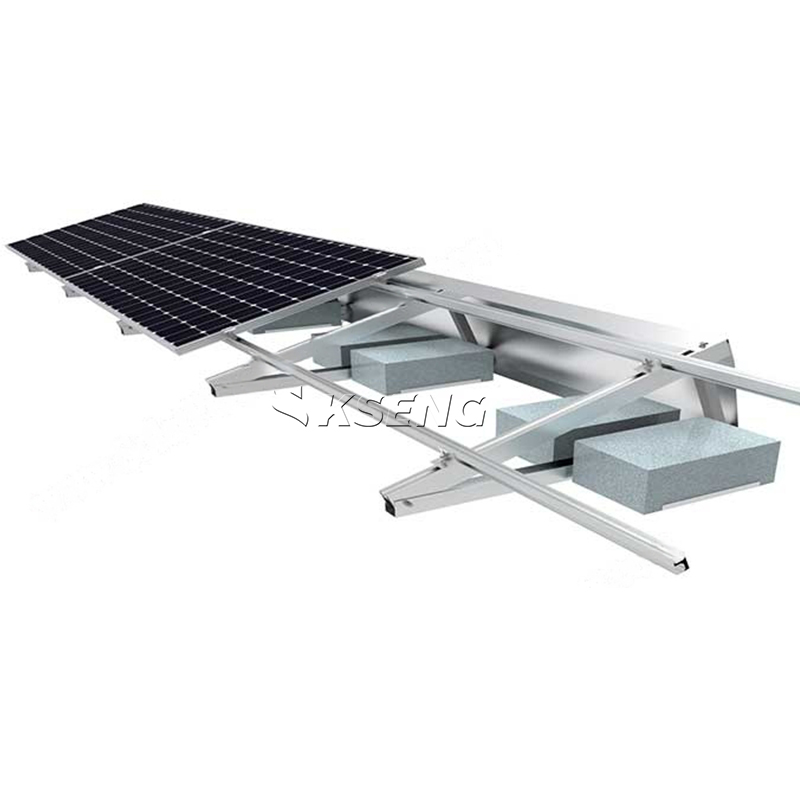
East-West configurations flip the traditional solar model on its head. Instead of chasing maximum individual panel efficiency, they maximize the spatial efficiency of the entire roof. By placing panels back-to-back in an inverted V or ∧ shape, the system eliminates the need for large shading clearances. One panel slopes east, and its partner slopes west. Because their highest points meet in the middle, they do not cast long shadows onto adjacent rows. This layout significantly increases the total kilowatt capacity of a restricted roof area. You can often pack 30% more panels onto the same square footage.
Beyond density, this orientation fundamentally alters how and when you produce power. East-West setups flatten the generation curve. A south-facing system creates a sharp, tall mountain of power at noon. An East-West system creates a wider, dual-peak generation profile. The eastern panels catch the early morning sun. The western panels capture the late afternoon and early evening light. This wider curve aligns beautifully with modern Time-of-Use (TOU) tariffs. Utilities often charge premium rates during late afternoon hours when grid demand spikes. Generating your own power during these expensive hours drastically improves your financial return under self-consumption models.
The hardware advantage of this layout proves equally compelling. The closed, back-to-back profile drastically reduces wind uplift. Wind simply glides over the aerodynamic ∧ shape instead of getting trapped underneath. This makes the East-West configuration the ideal scenario for a Ballasted Solar Mount for Flat Roof application. Because the wind cannot lift the panels easily, the system requires far less heavy concrete. You can achieve safe, lightweight installations without penetrating the membrane or voiding roof warranties.
East-West configurations act as the best fit for space-constrained commercial roofs. They excel on older buildings facing strict structural payload limits where heavy concrete is impossible. Additionally, they suit geographic regions with grid profiles that penalize peak midday grid exports. If your utility pays you very little for sending power back at noon, spreading your generation into the morning and evening makes far more economic sense.
| Feature Category | South-Facing Setup | East-West Setup |
|---|---|---|
| Panel Density | Lower (Requires wide row spacing) | High (Back-to-back, tight packing) |
| Peak Generation Time | Midday (Sharp noon peak) | Morning & Late Afternoon (Flat curve) |
| Wind Uplift Risk | High (Acts as an open sail) | Low (Aerodynamic closed profile) |
| Ballast Weight Required | Heavy (High concrete demands) | Light (Minimal concrete needed) |
Choosing your structural layout requires a strict evaluation of engineering and electrical realities. Facility managers must look beyond simple energy estimates. You need a comprehensive understanding of how the array interacts with the physical building. A successful flat roof solar panel mounting project requires balancing three major engineering criteria.
Roof Payload & Structural Integrity
Inverter and String Sizing Requirements
Maintenance and Soiling Limitations
First, consider your roof payload and structural integrity. You must actively compare the per-square-foot load of heavily ballasted south-facing systems versus aerodynamic East-West systems. Many commercial buildings, especially large warehouses, feature strict dead load limits. Heavy south-facing ballasts may exceed these structural thresholds, forcing expensive building reinforcements. A high-quality Non-Penetrating Flat Roof Mount System designed for East-West layouts typically distributes weight much more evenly. Furthermore, you must evaluate drainage impacts. Mounting rails and heavy concrete blocks can dam rainwater. Ensure the chosen racking hardware does not block natural water flow or create pooling on low-slope surfaces.
Next, carefully review your inverter and string sizing requirements. East-West arrays introduce specific electrical demands. The eastern panels wake up and produce high voltage in the morning, while the western panels sit in relative shadow. You cannot wire these two opposing sides into the same traditional inverter channel without losing massive efficiency. We note the technical necessity of dual Maximum Power Point Tracking (MPPT) inverters for East-West arrays. Dual MPPT allows the inverter to manage disparate voltage curves independently, treating the east panels and west panels as separate distinct power plants.
Finally, address maintenance and soiling, commonly known as self-cleaning limits. Pitch angle matters. South-facing panels generally sit at steeper angles (20 to 30 degrees). This steep angle helps rainwater naturally wash away dust, bird droppings, and industrial soot. East-West systems are typically mounted at much shallower angles (10 to 15 degrees) to minimize wind loads and prevent adjacent shading. This shallow slope drastically reduces natural rain-washing. Facility managers must plan for more frequent manual cleaning schedules to prevent dirt accumulation from degrading the system's energy yield.
As you move closer to procurement, mitigating project risks becomes your primary responsibility. Every roof behaves differently. Relying on generalized solar quotes without site-specific engineering can lead to disastrous financial and structural outcomes. Facility managers must evaluate installer proposals with a highly critical eye.
Spotting Red Flags in Generation Estimates: Watch out for installers who fail to account for inter-row shading on south-facing proposals. Likewise, ensure they do not overstate morning yields on East-West configurations by ignoring local horizon shading (like nearby trees or taller buildings).
Demanding Accurate Payload Models: Never accept a quote that lacks a preliminary ballast plan. Installers must prove they understand your specific structural limits before you sign a contract.
Scrutinizing Hardware Selection: Confirm the racking hardware carries extensive wind tunnel testing certifications. Generic rails will not suffice on commercial flat structures.
Navigating wind and snow loads requires localized engineering reports. While utilizing a non-penetrating solution remains highly desirable to protect membrane warranties, winter weather introduces unique risks. Snow accumulation heavily impacts East-West arrays. In a south-facing setup, snow tends to slide off the panel onto the empty roof gap. In an East-West array, snow slides down the panels directly into the V-shaped valley between the rows. This concentrates massive, dense weight into a very tiny structural area. An engineer must certify that these localized point loads will not push the roof deck beyond its safe limits.
Finally, factor in strict compliance and permitting constraints. Fire setbacks are non-negotiable. Local fire codes mandate clear pathways around the perimeter of the roof and between panel blocks so firefighters can safely navigate. These edge-zone clearances create mandatory dead zones. You must factor these dead zones into your total density calculations before finalizing your orientation strategy. An East-West system might look perfect on paper, but if fire setbacks eat up 20% of your roof space, your total capacity will drop accordingly.
Choosing between an East-West and a South-facing solar array dictates the fundamental success of your commercial installation. The decision matrix ultimately relies on your specific building constraints and utility rate structures. You should choose a south-facing orientation to maximize the individual yield of each panel, provided your facility possesses abundant roof space, high structural payload limits, and high midday energy loads. Conversely, you should choose an East-West configuration to maximize the total generation capacity of the roof asset. This aerodynamic approach effectively mitigates harsh wind and weight risks while beautifully aligning your power output with premium Time-of-Use pricing models.
Your immediate next step involves demanding comprehensive data from your potential installation partners. Request dual-layout proposals showing both a traditional South-facing model and a dense East-West model. Insist that these proposals include full 8760-hour generation profiles to see exactly when the power hits your building. Finally, require detailed ballast weight calculations upfront to ensure the proposed mounting architecture aligns perfectly with your building's structural realities.
A: Individually, yes. A single panel facing east or west typically produces about 10% to 15% less total energy annually compared to a perfectly south-facing panel. However, because you can pack up to 30% more panels onto the same flat roof without inter-row shading gaps, the total energy capacity of the entire roof is usually much higher.
A: Yes, but it requires substantial trade-offs. South-facing panels catch wind like an open sail, creating massive uplift forces. To avoid roof penetrations, you must use heavily ballasted racks filled with concrete blocks. If your roof structure cannot handle this extreme weight, you will be forced to use mechanical penetrations.
A: Low tilt angles, common in East-West setups, struggle during winter. The lower winter sun hits shallow panels at a less optimal angle, reducing daily generation. Additionally, a shallow pitch prevents snow from sliding off naturally. You may experience prolonged energy loss until the snow melts or is manually cleared.
A: Microinverters are not strictly required, but specific inverter technology is necessary. Because eastern panels peak in the morning and western panels peak in the afternoon, they operate on different voltage curves. You can use standard string inverters if they feature dual MPPT (Maximum Power Point Tracking) to manage the two orientations independently.





