Views: 0 Author: Site Editor Publish Time: 2026-06-07 Origin: Site


Utility-scale solar developers and EPCs face a relentless balancing act. You must constantly weigh the higher upfront CAPEX of tracking systems against the strict necessity of maximizing energy yield. While independent single-axis architectures have long dominated the utility landscape, recent component inflation and operational complexities have forced a strategic pivot. We are now seeing a massive industry shift toward mechanically optimized layouts.
A dual-row linkage solar tracker system offers a measurable reduction in Levelized Cost of Energy (LCOE) for relatively flat topographies. It achieves this by drastically reducing electrical failure points without sacrificing the 15–25% yield boost typical of active tracking installations. In this guide, you will learn the exact mechanical principles behind dual-row linkages. We will explore site suitability metrics, break down procurement frameworks, and compare this setup directly against fixed-tilt and independent-row alternatives.
Halved Electrical Complexity: Linking two rows to a single slew-drive motor reduces control units and motors by up to 50%, directly lowering failure rates.
Strict Site Parameters: Maximum cost-efficiency is achieved on sites with N-S slope tolerances below 10–15%; highly undulating terrain may still require independent row designs.
O&M Cost Reduction: Fewer active components and ultra-low daily power consumption (often <0.1 kWh/day) drive long-term financial viability.
Large-Format Compatibility: Modern mechanical linkage systems are specifically engineered to support high-wind loads for ultra-large (210mm/600W+) bifacial modules.
Engineers consistently look for ways to do more with fewer moving parts. For years, the industry standard involved powering every solar array row independently. Each row had its own motor, its own battery backup, and its own communication node. While this offered maximum flexibility on uneven ground, it also multiplied the number of potential failure points across a massive site.
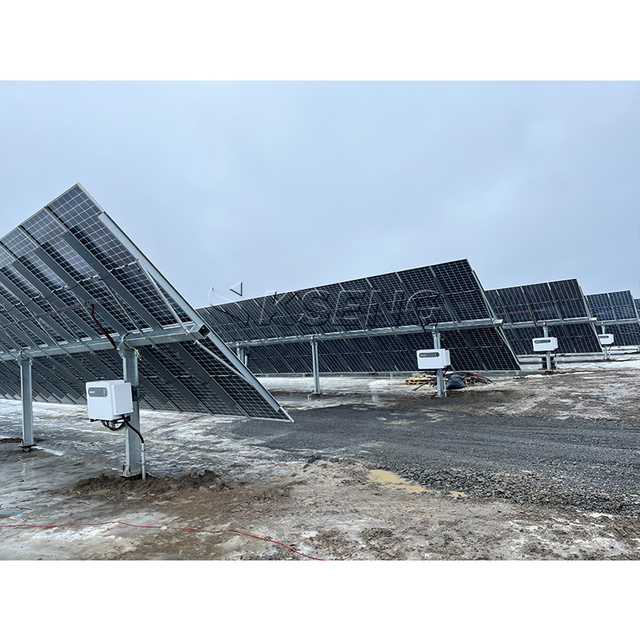
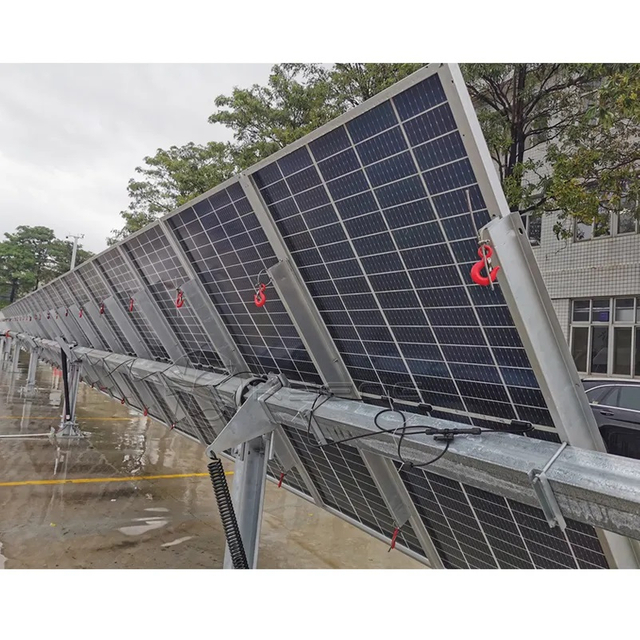
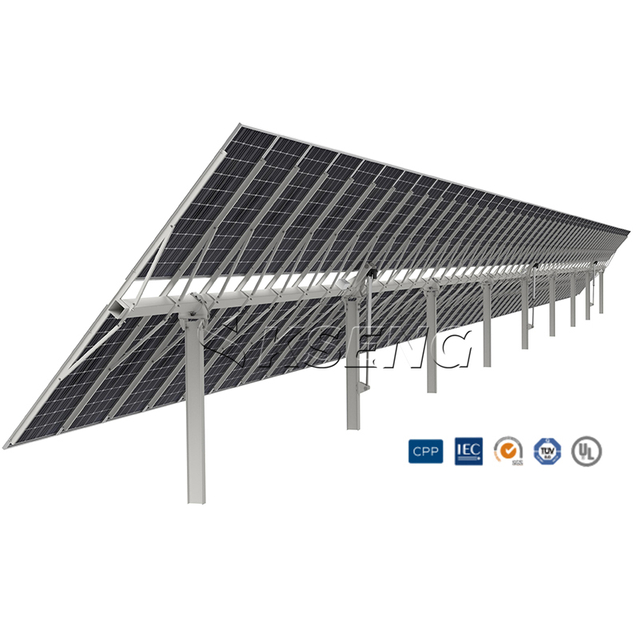
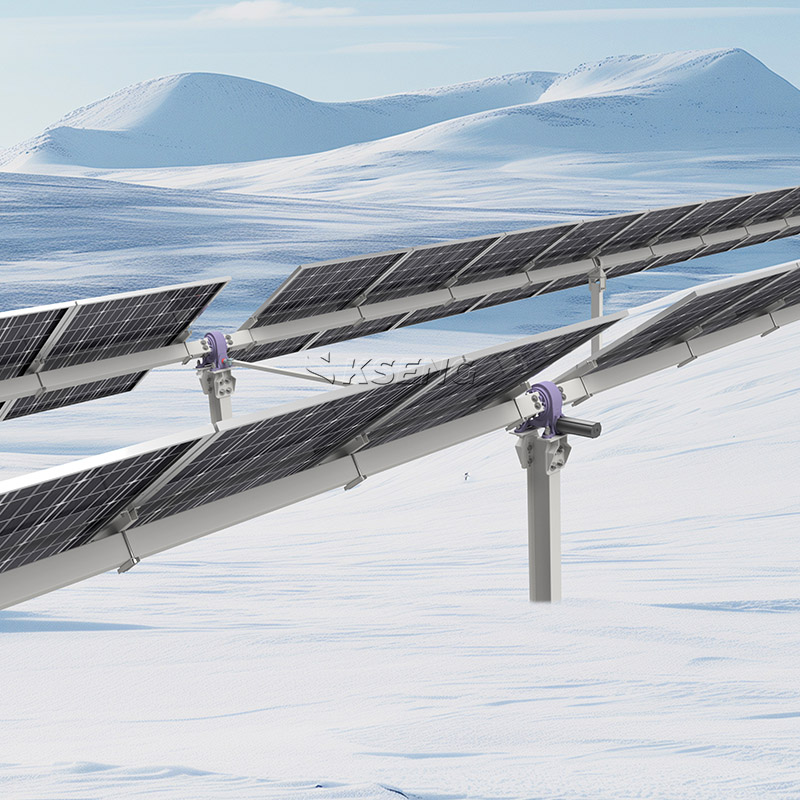
Dual-row linkage architecture changes this approach. It relies on fundamental mechanical simplification. Instead of duplicate electrical components, it utilizes a single high-power slew-drive motor. This central motor connects to adjacent rows using robust mechanical linkages. Manufacturers commonly use spline shafts and Cardan joints for this purpose. Cardan joints are particularly valuable. They act as universal joints, allowing slight articulation so the linked rows can handle minor terrain variations without binding.
Linking two massive rows of solar panels does more than just share a motor. It fundamentally alters the structural dynamics of the array. The linked architecture actively shares wind loads and structural stresses across a much larger physical footprint. This wider base improves the natural vibration frequency of the entire array. Consequently, the system resists galloping and wind-induced resonance far better than a standalone row. When sudden gusts hit the site, the rigid steel linkages distribute the twisting forces safely into the foundation.
Managing row-to-row shading is a critical challenge during early morning and late afternoon hours. A traditional setup risks shading adjacent panels if one motor lags slightly behind the others. However, a one axis solar tracking system utilizing dual-row linkages solves this issue organically. Because the rows are physically tied together, they maintain perfectly synchronized movement. They virtually eliminate the risk of accidental row-to-row shading. When driven by unified AI-driven backtracking algorithms, this rigid synchronization ensures optimum sunlight capture during low-angle sunlight hours.
Moving from independent rows to linked architecture requires a close look at the project ledger. The financial benefits of dual-row setups appear in both the initial procurement phase and long after commissioning. By replacing electronics with structural steel, EPCs drastically alter the cash flow profile of utility-scale developments.
Hardware cost savings represent the most immediate benefit. When you link rows, you effectively trade duplicate motors, backup batteries, and localized controllers for steel mechanical shafts. Steel is inherently cheaper and less subject to semiconductor supply chain volatility than microchips and circuit boards. This direct trade-off lowers the initial bill of materials. You buy half the motors, half the communication nodes, and half the localized power supplies.
The long-term impact on the Operations and Maintenance (O&M) ledger is profound. Consider the reality of a field technician. Troubleshooting one motor and one communication node for every roughly 240 panels is highly efficient. In an independent row system, that same technician must inspect nodes for every 120 panels. Fewer electronic nodes mean fewer truck rolls, fewer firmware updates, and fewer spare parts rotting in a warehouse. Furthermore, modern linkage motors are highly efficient. They often boast ultra-low daily power consumption, sometimes using less than 0.1 kWh per day.
Skeptics often wonder if mechanical linkages restrict movement. They do not. Dual-row systems provide the exact same tracking range as premium independent tracking architectures. You still get the standard ±60° range of motion. You still achieve the critical ±1° tracking accuracy. Because the performance metrics remain identical to independent rows, dual-row systems ensure the expected revenue generation modeled during the initial financing phase.
When selecting a single axis solar tracker for a major project, engineers must look past marketing claims. You need a rigorous evaluation framework. We highly recommend using the industry-standard four-pillar specification breakdown to assess any mechanical linkage system.
You must evaluate the main beam cross-section and its overall stiffness. The solar industry is rapidly moving toward ultra-large bifacial modules. These 210mm, 600W+ panels are heavy, often exceeding 2.5 meters in length. The system must accommodate these massive panels without suffering excessive deflection under load. Ask your vendor for specific wind tunnel data confirming structural rigidity for large-format modules.
Look beyond the basic sun-tracking timer. Modern projects require closed-loop AI control systems. These systems should prioritize advanced astronomical algorithms while featuring active weather overrides. Also, assess the communication protocol reliability. Hardwired systems are stable but expensive to trench. Look for decentralized mesh networks using protocols like Zigbee, LoRa, or RS485. These ensure the system still communicates even if one local node drops offline.
Scrutinize the wind-stow metrics closely. Extreme weather is the greatest threat to a solar asset. A viable utility-scale solar tracker must guarantee an emergency flat-stow time of under 6 to 8 minutes. The system must initiate this rapid stow sequence the moment local anemometers detect wind speeds exceeding 18m/s. Verify that the system has sufficient backup power to execute this move during a grid outage.
Verify the operating temperature ranges. A standard utility system should operate flawlessly from -30°C to +60°C. Additionally, check the Ingress Protection (IP) ratings of the reduced motor housings. Since there are fewer motors in a dual-row setup, the ones you do have must be hermetically sealed against dust, sand, and driving rain.
Dual-row linkages are exceptional, but they are not magical. They face strict physical constraints. Before you commit to a linked architecture, you must thoroughly evaluate the real-world conditions of your designated site.
Mechanical linkages require precise alignment over long distances. Sites with heavy North-South undulation or extreme East-West grade changes will cause severe problems. If the slope exceeds a 15% grade, the rigid steel linkages will bind, causing premature motor burnout. Highly undulating terrain drastically increases the risk of installation delays. For heavily rolling hills, independent rows remain the safer choice.
Consider the reality of field deployment. While halving the electrical wiring saves time, the mechanical assembly requires rigorous pile-driving accuracy. EPCs must factor in precise structural leveling. If the driven piles are off by just a few inches, connecting the rigid drive shaft between two rows becomes an arduous, labor-intensive struggle. Surveyors and pile-driving operators must maintain incredibly tight tolerances to ensure the mechanical joints seat properly.
Integrating the correct foundation type is critical to maintaining linkage integrity over a 25-year asset lifecycle. Soil shifting will destroy a mechanical linkage. In areas prone to heavy frost heave or loose sandy soils, standard driven H-piles might not suffice. You may need to specify ground screws or concrete-cast foundations to prevent uneven settling. If one row settles more than its linked partner, the resulting torque will tear the Cardan joints apart.
Choosing the right mounting structure dictates the financial heartbeat of your solar farm. To simplify the decision, we must evaluate how dual-row systems stack up against the two other dominant methodologies: fixed-tilt systems and independent-row trackers.
Fixed-tilt systems are the simplest. They involve zero moving parts, resulting in near-zero maintenance. They are practically indestructible in high winds. However, this safety comes at a massive cost to yield. Fixed systems typically suffer a 15–25% yield loss compared to tracking arrays. Furthermore, they feature a highly concentrated midday production profile. In modern energy markets dominated by Time-of-Use (TOU) pricing, peak energy demand often occurs in the late afternoon. Trackers catch this lucrative afternoon sun, whereas fixed systems miss it entirely. This makes fixed-tilt systems highly uncompetitive in regions with variable energy pricing.
The dividing line between independent and dual-row trackers is straightforward: topography. Independent row trackers feature a dedicated motor per row. This allows them to step seamlessly over complex, hilly terrain without binding. If your site looks like a roller coaster, choose independent rows. However, if your terrain is flat-to-moderate, independent rows represent wasted CAPEX. For flat sites, choosing dual-row linkage is the ultimate financial directive. It strips away redundant hardware costs and slashes O&M overhead.
To provide clear clarity, review the following functional comparison of the three primary architectures:
| Metric | Fixed-Tilt Array | Independent Row Tracker | Dual-Row Linkage Tracker |
|---|---|---|---|
| Energy Yield Boost | Baseline (0%) | + 15% to 25% | + 15% to 25% |
| Terrain Tolerance | Very High (All Slopes) | High (Complex Hills) | Moderate (<15% Slope) |
| Electrical Complexity | Zero | High (1 motor per row) | Low (1 motor per 2 rows) |
| CAPEX Profile | Lowest | Highest | Moderate |
| Best Use Case | Extreme weather, cheap land | Highly undulating topography | Flat topography, budget-focused |
Dual-row linkage tracking is not a universal silver bullet for every solar farm. It is a highly optimized, high-ROI engineering solution designed for specific geographical profiles. By sharing a single slew-drive motor across two distinct rows, you strip out massive amounts of redundant electronics. This mechanical simplification naturally lowers both your initial capital expenditure and your long-term maintenance costs.
As you plan your next utility-scale deployment, your next steps must be data-driven. First, conduct a rigorous terrain slope analysis to ensure your site falls within the required 10–15% N-S slope tolerance. Next, engage with your solar energy tracker manufacturer to request specific wind-tunnel test data verifying large-format module compatibility. Finally, demand customized LCOE modeling that contrasts dual-row linkages directly against independent architectures for your specific geographic coordinates. By evaluating the structural realities alongside the financial data, you will guarantee maximum profitability for your asset.
A: Maximum cost-efficiency requires relatively flat terrain. Typically, dual-row trackers accommodate a 10% to 15% North-South slope tolerance. The exact limit depends heavily on the manufacturer's specific Cardan joint or mechanical linkage design. Steeper sites usually require transitioning to independent row architectures to prevent linkage binding.
A: Yes. Modern linkage designs are built specifically for heavy bifacial modules. They maintain high ground clearance, often exceeding 500mm. Furthermore, engineers carefully design the primary torque tubes and mechanical linkages to minimize structural shadowing. This layout maximizes the critical albedo light capture on the rear side of the panels.
A: Utility-scale linkage systems incorporate localized fail-safes. They utilize self-powered backup strings or dedicated, weather-sealed backup batteries at the motor node. This localized power ensures the array can independently execute an emergency flat-stow command within minutes during severe weather, even if the primary utility grid drops offline.