Views: 0 Author: Site Editor Publish Time: 2026-06-04 Origin: Site


Engineering procurement companies and developers face a persistent dilemma. They must balance the proven 25 to 35 percent yield increase of tracking mechanisms against the perceived risks of higher initial capital expenditure and operational maintenance. Moving parts inherently introduce skepticism into long-term infrastructure planning. Modern tracking systems stand in stark contrast to their legacy predecessors. Recent advancements in wireless mesh networks, backtracking algorithms, and modular mechanical designs fundamentally alter the risk-to-reward ratio. Today, intelligent controllers and self-lubricating joints replace rigid hardware and failure-prone hydraulics. A transparent, evidence-based evaluation of a one axis solar tracking system requires looking beyond theoretical energy gains. You must examine real-world installation realities, component durability, and lifecycle costs. This guide explores how intelligent software, terrain-adaptive structures, and strategic maintenance protocols maximize energy generation without compromising reliability.
Yield vs. Cost: Modern utility-scale systems average $0.15–$0.25/W, delivering a 25–35% generation boost and achieving a 5–10 year payback period.
Terrain Adaptability: Advanced articulating joints and telescoping legs eliminate the need for expensive land grading (which historically consumed 3–14% of project budgets).
O&M Evolution: The shift from hydraulic to VFD-controlled electric drives, combined with self-lubricating bearings, drastically reduces manual maintenance cycles.
Software Intelligence: GPS-synced backtracking algorithms and solid-state inclinometers (accurate to 0.09 degrees) mitigate inter-row shading, especially on undulating topography.
Solar developers must justify every upfront infrastructure investment through verifiable energy output. Understanding the business problem requires framing generation gains against realistic capital allocations. When you implement a single axis solar tracker, baseline energy gains typically hover between 25 and 35 percent compared to standard fixed-tilt systems. This performance boost fluctuates based on your specific latitude and the site’s direct normal irradiance (DNI). Locations closer to the equator often see different seasonal benefits than higher latitude environments.
You should also evaluate specific tracking configurations, such as the T20 tilt factor. Horizontal single-axis trackers (HSAT) dominate standard utility-scale projects due to their simplicity. However, tilted single-axis systems (TSAT), configured with a 20-degree tilt, can unlock additional capacity. Tilting the tracker slightly captures winter sun more effectively in specific geographic zones, yielding an extra 6 to 7 percent in energy generation over standard horizontal configurations.
Capital expenditure realities remain highly competitive. Utility-scale deployments currently average between $0.15 and $0.25 per watt. When you map this initial cost against the generated energy surplus, projects reliably achieve a 5 to 10 year payback period. Long-term profitability heavily depends on accurate forecasting rather than optimistic laboratory numbers.
We advise buyers to model their Levelized Cost of Energy (LCOE) carefully. You must use conservative weather data and typical meteorological year (TMY) datasets. Avoid relying entirely on best-case scenario models provided by manufacturers. A rigorous LCOE analysis accurately factors in seasonal cloud cover and regional degradation rates, painting a realistic picture of your return on investment.
| System Type | Average Output Gain | Optimal Latitude | CapEx Impact |
|---|---|---|---|
| Standard Fixed-Tilt | Baseline (0%) | Any (less efficient overall) | Lowest Initial Cost |
| Horizontal Single-Axis (HSAT) | +25% to +35% | Low to Mid Latitudes | $0.15 - $0.25 / W |
| Tilted Single-Axis (TSAT) | +31% to +42% | High Latitudes (Winter focus) | Slightly higher due to structural wind loads |
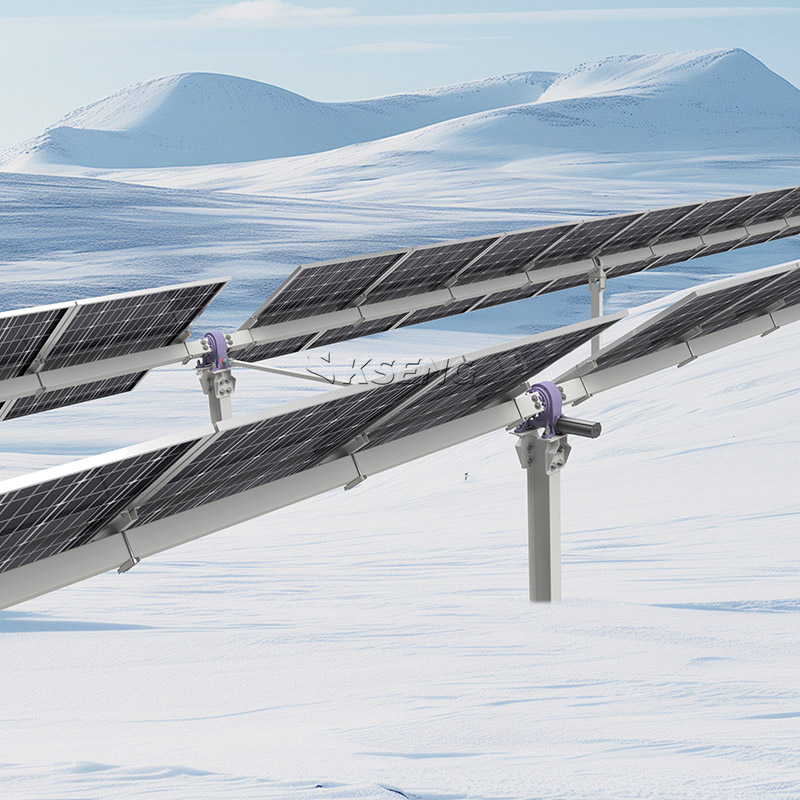
Modern developers increasingly target undulating, sub-optimal land parcels because flat, ideal topography is scarce and expensive. This shift introduces significant civil engineering risks. Traditionally, civil works and extensive land leveling consumed up to 14 percent of total project budgets. Moving massive volumes of dirt not only drains capital but also creates environmental compliance hurdles.
Advanced engineering now resolves the rigid "flat land" requirement. All-Terrain Trackers (ATT) introduce flexible architectures designed specifically for rolling hills. These systems utilize pre-cast concrete foundations, telescoping legs, and flexible drive shafts. Instead of flattening the earth to accommodate the tracker, the tracker physically adapts to the natural contours of the site.
Implementation realities heavily depend on installation tolerances. Legacy tracking equipment required rigid, highly unforgiving installation tolerances of +/- 3 inches. Hitting those marks on a sloped site resulted in massive labor cost overruns and continuous rework. Conversely, modern flexible architectures confidently accommodate variances up to +/- 12 inches. This wider margin drastically reduces rework, accelerates deployment schedules, and mitigates structural misalignment risks.
Deploying a solar tracker system successfully requires a standardized implementation Standard Operating Procedure (SOP). Strict adherence to these phases ensures mechanical stability.
Foundation Preparation: Conduct pull-out testing and drive piles according to localized geotechnical reports.
Structural Mounting: Install telescoping legs and torque-tubes, ensuring articulable joints are properly seated.
Drive Mechanism Integration: Attach linear actuators or slewing drives, taking care not to bind the flexible drive shafts.
Alignment Quality Checks: Perform rigorous inspections confirming smooth mechanical rotation and verifying stringent electrical insulation safety standards.
The core intelligence of tracking hardware lies within its sensing methodology and actuation components. Historically, systems relied on Light Dependent Resistors (LDR) to sense the brightest point in the sky. These closed-loop sensors are inherently reactive. When cloud cover obscures the sun, LDRs often become confused, causing the tracker to hunt erratically and waste motor energy.
Today, the industry prefers calculating the sun's position rather than reacting to it. Modern GPS-driven astronomical clock systems utilize precise algorithms to determine the exact solar angle based on time, date, and location. Because GPS configurations integrate seamlessly with weather forecasting software, they offer superior reliability. The solar energy tracker smoothly navigates cloudy conditions without erratic mechanical movements.
Actuation hardware has also undergone a radical transformation. Early iterations utilized hydraulic drives, which suffered from high failure rates, fluid leaks, and temperature sensitivities. Modern developers overwhelmingly prefer Variable Frequency Drive (VFD) controlled electric gear motors and linear actuators. Electric systems offer an industrial-grade lifespan, simplified troubleshooting, and vastly lower replacement costs.
Perhaps the most critical software development is the advanced backtracking algorithm. On uneven terrain, trackers facing the sun during early morning or late evening often cast long shadows onto parallel rows. Inter-row shading disproportionately cripples energy production due to string-level voltage drops. Backtracking software solves this by implementing row-by-row tilt schedules. The system deliberately de-tunes the angle of the panels, sacrificing a tiny fraction of direct irradiance to eliminate shadows entirely. This intelligent compromise maximizes the total output of the entire array.
| Feature | Legacy Systems | Modern Systems |
|---|---|---|
| Sun Sensing | LDR Sensors (Reactive) | GPS Astronomical Clock (Predictive) |
| Actuation Type | Hydraulic Drives | VFD-Controlled Electric Motors |
| Shade Mitigation | None / Hard stops | 3D Topographic Backtracking |
| Position Accuracy | Standard Potentiometers | Solid-State Inclinometers (0.09° accuracy) |
Deploying infrastructure meant to endure harsh outdoor environments for a quarter of a century demands rigorous lifecycle cost management. Operational expenses quickly erode profitability if component reliability falters. Strategic material selection is the first line of defense against environmental degradation.
Corrosion Resistance: You must utilize high-grade anodized aluminum or heavily galvanized steel. These materials survive 25 years of relentless UV exposure, moisture, and extreme temperature fluctuations without compromising structural integrity.
Friction and Wear Reduction: Mechanical breakdowns usually originate at high-friction connection points. Simplifying articulable joints and utilizing self-lubricating, maintenance-free polymer bearings effectively eliminate routine manual lubrication schedules.
Modular Component Replacement: Procurement teams should prioritize modular architectures. When a solid-state inclinometer or a single actuator fails, maintenance crews must be able to hot-swap the specific part. Dismantling the broader array or compromising torque-tube stability to replace a single motor is a catastrophic waste of labor.
The most profound shift in maintenance strategy comes from integrating the Internet of Things (IoT). Modern controllers utilize self-powered wireless communication networks, such as Zigbee mesh networks, to bypass expensive trenching and communication wiring. These sensors continuously send digital twin data and real-time stress analytics to a centralized dashboard. This visibility allows facility managers to monitor the exact strain on individual rows during high wind events. By shifting from reactive repairs to predictive asset management, operators intervene only when a specific component flags an anomaly, drastically lowering routine labor costs for the solar tracker array.
Deciding to implement moving arrays requires aligning site-specific data with vendor capabilities. A rigid shortlisting logic protects you from acquiring systems incompatible with your land or budget. The first step involves creating a site suitability matrix.
You must weigh your project’s latitude, the average direct normal irradiance (DNI), and the terrain slope. Flat desert environments with high DNI are undeniable candidates for horizontal tracking. Conversely, steep southern-facing slopes might necessitate highly specialized articulating trackers or even dictate a return to fixed-tilt racking if the grade exceeds mechanical safety limits.
Once you verify site suitability, rigorous vendor evaluation becomes paramount. Do not treat all steel and software as equal. Ask potential partners direct, technical questions:
Do they offer wireless string communication to save on expensive trenching and alternating current (AC) cabling?
Are the local control panels built using off-the-shelf industrial Programmable Logic Controllers (PLCs) that your technicians can replace easily, or do they rely on proprietary, black-box circuitry?
Can the vendor provide verifiable wind-tunnel testing data proving mechanical stability? What are their exact stow-mode response times during sudden gale-force events?
Before issuing a formal Request for Proposal (RFP), we strongly recommend commissioning a site-specific LCOE software simulation. Utilize industry-standard platforms like PVSyst integrated directly with the vendor's proprietary backtracking algorithms. This simulation validates claims and sets a definitive performance baseline for the project.
The decision to implement a tracking system is no longer a gamble on mechanical reliability. Instead, it is a calculated engineering decision based on advanced terrain adaptability and sophisticated software intelligence. Modern hardware effectively mitigates the traditional risks associated with structural stress and manual lubrication.
Prioritize vendors that offer robust structural warranties and hot-swappable modular replacement parts. Favor partners who demonstrate advanced backtracking software capabilities over those simply competing on raw steel pricing. By focusing on predictive maintenance frameworks and flexible site integration, developers can confidently capture 25 to 35 percent yield increases while strictly controlling lifecycle maintenance expenditures.
A: These systems move extremely slowly, rotating at approximately 15 degrees per hour. This gradual movement perfectly matches the sun’s trajectory across the sky. Because the motion is almost imperceptible, it causes negligible mechanical strain on the drive motors and structural joints.
A: Modern installations utilize automated anemometer integration. When wind speeds exceed safe thresholds, the sensors trigger an active "stow mode." This automated response rotates the panels into a flat, aerodynamically safe angle to prevent mechanical failure and panel uplift.
A: Yes. Advanced tracking systems often feature self-powered row controllers. These controllers are equipped with dedicated micro-panels and backup batteries, completely eliminating the need for expensive underground AC trenching and hardwired communication lines.
A: Dual-axis systems capture up to 45–50% more energy by tracking both azimuth and elevation. However, they require significantly higher operational maintenance and much wider land spacing to prevent shading. Consequently, single-axis systems remain the undisputed standard for maximizing utility-scale return on investment.