
Views: 0 Author: Site Editor Publish Time: 2026-08-14 Origin: Site


Agrivoltaics, also known as Agri-PV or agricultural photovoltaics, is becoming an increasingly important solution for combining renewable energy generation with agricultural production. By installing photovoltaic modules above or around agricultural land, Agri-PV systems enable farmers and solar developers to make more efficient use of land while generating clean electricity.
However, successful Agri-PV projects require much more than simply installing solar panels over farmland. The mounting structure must be carefully designed to meet both agricultural and photovoltaic requirements. Among the most important design factors are mounting structure height and row spacing.
The right Agri-PV structure height and spacing can improve crop growth conditions, provide sufficient space for agricultural machinery, optimize sunlight distribution, and maintain efficient solar power generation. Therefore, these parameters should be carefully evaluated during the early stages of project design.
Traditional ground-mounted solar systems are generally designed to maximize solar capacity and energy generation within a specific land area. Agri-PV systems have an additional requirement: agricultural activities must remain practical and productive.
The mounting structure needs to provide enough clearance for crops, workers, tractors, harvesters, irrigation systems, and other agricultural equipment. At the same time, the PV array must receive sufficient solar radiation to achieve the expected energy yield.
Increasing the mounting height can improve agricultural accessibility, but it may also increase structural material requirements and wind loads. Similarly, increasing row spacing can improve sunlight penetration and machinery access, but it can reduce the number of PV modules that can be installed within a given land area.
This means that Agri-PV design is essentially a balance between agricultural productivity, solar energy generation, structural safety, and project economics.
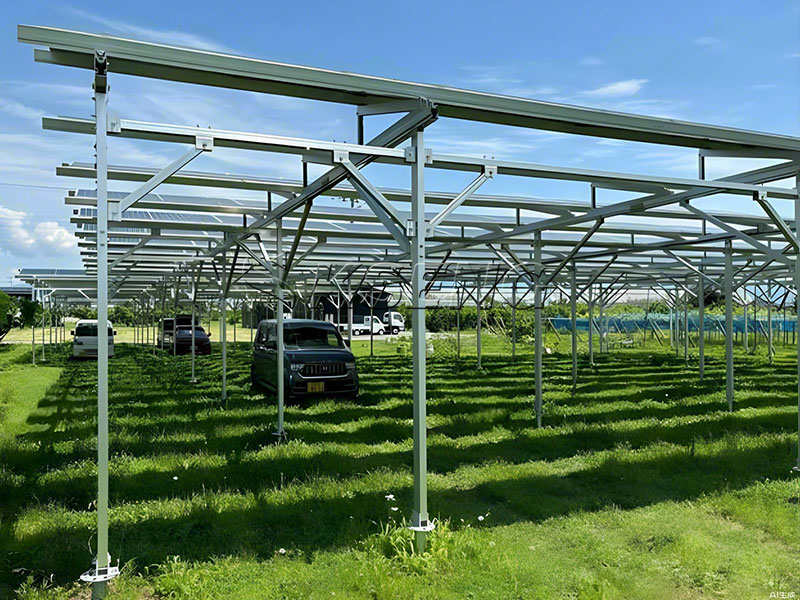
There is no universal mounting height that is suitable for every Agri-PV project. The appropriate height depends on crop type, agricultural machinery, site conditions, PV module configuration, and local environmental conditions.
The first factor to consider is the crop itself.
Low-growing vegetables and horticultural crops generally require less vertical clearance than vineyards, orchards, or crops that require large machinery.
The structure should be designed according to the mature growth height of the crop rather than only the height of newly planted crops. Sufficient clearance should also be provided for crop maintenance, harvesting, and other agricultural activities.
Agricultural machinery is one of the most important factors when determining Agri-PV structure height.
The design should consider the actual dimensions and operating requirements of equipment such as tractors, harvesters, sprayers, cultivators, and irrigation machinery.
Important parameters include:
Machine height
Machine width
Operating clearance
Turning radius
Implement dimensions
Maintenance access
Harvesting requirements
For large-scale agricultural operations, the structure may need significantly greater clearance to allow machinery to operate efficiently beneath the PV array.
In addition to machinery, sufficient clearance should be provided for workers and maintenance personnel.
Farm workers may need to move through the PV area for planting, irrigation, inspection, pruning, harvesting, and equipment maintenance.
A well-designed Agri-PV system should therefore integrate agricultural access into the structural layout from the beginning.
Row spacing refers to the horizontal distance between adjacent rows of PV modules or support structures.
The correct spacing has a direct impact on solar radiation, crop shading, agricultural machinery access, land utilization, and overall project economics.
If the spacing is too narrow, the crop may receive excessive shade and agricultural machinery may have difficulty operating between the rows.
If the spacing is too wide, crop access and sunlight conditions may improve, but the overall PV capacity per unit of land may decrease.
The optimal row spacing should therefore be determined based on the specific objectives of the project.
Sunlight is essential for both photovoltaic power generation and crop growth.
Agri-PV designers should evaluate the movement of the sun throughout the year and understand how the PV modules will cast shadows on the agricultural area.
The shading pattern depends on several factors, including:
Geographic location
Latitude
Solar elevation angle
Module orientation
Module tilt angle
Structure height
Row spacing
Module dimensions
Seasonal solar conditions
A higher mounting structure can change the distribution of shadows, while wider row spacing can reduce inter-row shading.
However, increasing structure height or row spacing alone does not guarantee better agricultural conditions. A complete solar and crop shading analysis should be performed for the specific project site.
Different crops have different sunlight requirements and different levels of shade tolerance.
Many vegetables require substantial sunlight for photosynthesis and healthy growth. Excessive shading may negatively affect crop development.
For these projects, designers should carefully optimize module density, structure height, and row spacing to maintain an appropriate level of solar radiation.
Certain berries and horticultural crops can tolerate or benefit from partial shading under specific environmental conditions.
In regions with high solar radiation or heat stress, PV modules may help reduce excessive solar exposure and create a more moderate growing environment.
However, the appropriate shading level varies by crop and climate, so project-specific agricultural analysis is essential.
Vineyards and orchards present different structural requirements because plants can grow significantly taller and require specialized agricultural operations.
The design should consider mature plant height, canopy development, harvesting equipment, pruning, irrigation, and long-term maintenance.
Field crops such as wheat, barley, corn, and other arable crops may require relatively wide equipment access.
For these applications, Agri-PV structures should be designed around the dimensions and operating patterns of agricultural machinery.
Structure height and row spacing should not be treated as independent parameters.
They interact with each other and influence the overall shading pattern and agricultural accessibility of the system.
For example, increasing the mounting height changes the shadow geometry beneath the array. Increasing row spacing can reduce inter-row shading but may also reduce PV capacity per hectare.
A practical Agri-PV design process should therefore consider the following sequence:
Crop requirements → Machinery requirements → Structure height → Solar geometry → Row spacing → PV capacity → Structural loads → Project economics
This integrated approach helps ensure that the solar system supports rather than interferes with agricultural operations.
Agri-PV mounting structures must be designed to withstand local environmental loads while maintaining the required agricultural clearance.
Important structural considerations include:
Wind loads
Snow loads
Seismic conditions
Module weight
Structural span
Foundation conditions
Soil characteristics
Corrosion environment
Drainage
Long-term durability
Elevated structures can experience greater wind exposure than conventional low-profile PV systems. As the structure becomes higher, the structural design and foundation requirements may also become more demanding.
Therefore, the structure height should be optimized not only for agricultural access but also for structural safety and project cost.
Agricultural environments can expose solar mounting structures to moisture, irrigation water, fertilizers, pesticides, and other corrosive substances.
Choosing appropriate structural materials and corrosion protection is therefore important for long-term system performance.
Depending on the project requirements, Agri-PV mounting structures may use materials such as:
Anodized aluminum
Hot-dip galvanized steel
Zinc-aluminum-magnesium coated steel
Stainless steel fasteners
Corrosion-resistant connection components
Material selection should be based on local environmental conditions, structural requirements, expected service life, and project economics.
A successful Agri-PV project must allow agricultural machinery to operate efficiently.
The layout should provide sufficient space for:
Planting
Irrigation
Fertilization
Spraying
Weeding
Harvesting
Equipment maintenance
Vehicle movement
Headland design is also important.
The headland is the area at the end of the crop rows where agricultural machinery turns around. Even if the distance between PV rows is sufficient, inadequate headland space can make agricultural operations difficult.
Therefore, the complete PV layout should be coordinated with the farmer's machinery and field operating pattern.
The main objective of Agri-PV is not simply to maximize solar power generation.
Instead, the goal is to create a balanced system that can support both agricultural production and renewable energy generation.
A project may prioritize solar energy generation, agricultural productivity, or an optimized combination of both.
The ideal configuration depends on:
Crop type
Climate
Solar radiation
Agricultural practices
Machinery requirements
Land availability
Electricity targets
Project investment
Local regulations
The best Agri-PV mounting system is therefore not necessarily the one with the highest PV density. It is the system that achieves the best overall balance between agricultural performance and solar energy production.
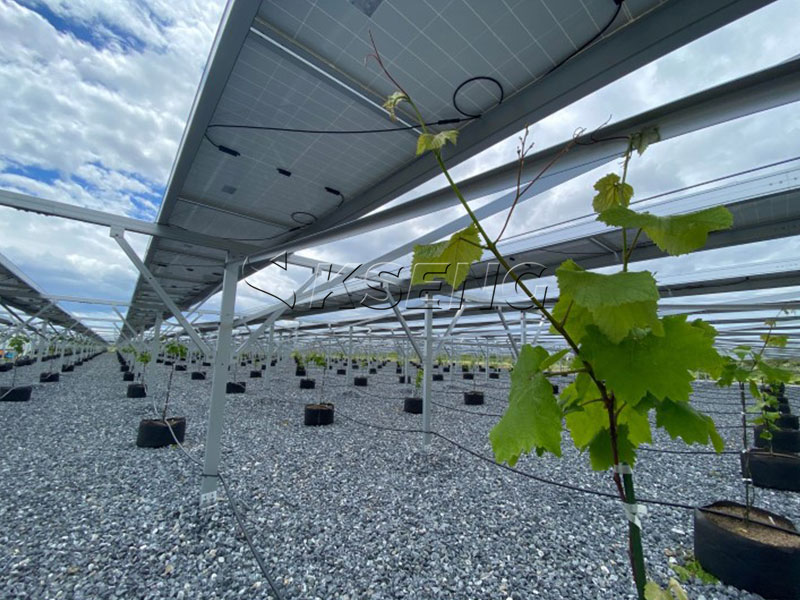
Agricultural land varies significantly from one project to another.
Different crops, climates, terrains, machinery, and farming methods require different mounting configurations.
For this reason, customized Agri-PV mounting structures can provide important advantages.
A customized design can consider:
Geographic location
Crop species
Crop growth height
Agricultural machinery
Required ground clearance
Solar radiation
Module dimensions
Module orientation
Module tilt angle
Desired shading conditions
Wind and snow loads
Soil conditions
Foundation type
Irrigation requirements
Target PV capacity
By integrating these factors into the design process, developers can create a solar mounting system that works with agricultural activities instead of limiting them.
Kseng Energy provides solar mounting solutions for agricultural, commercial, residential, and utility-scale applications.
Its Agri-PV mounting solutions are designed to combine photovoltaic power generation with agricultural activities while providing flexible structural configurations for different project requirements.
Depending on the project, the mounting structure can be customized according to factors such as structure height, row spacing, tilt angle, module arrangement, foundation type, and structural load requirements.
This flexibility enables Agri-PV developers, EPC contractors, solar installers, and agricultural businesses to develop solutions that are adapted to actual site and farming conditions.
Agri-PV mounting structure height and row spacing are two of the most important factors in the design of an agrivoltaic solar project.
The right structure height can provide sufficient clearance for crops, workers, and agricultural machinery, while the right row spacing can help optimize sunlight distribution, crop growth, and PV energy generation.
However, there is no single height or spacing value that works for every project.
A successful Agri-PV system should be designed according to crop characteristics, agricultural machinery, solar radiation, shading requirements, structural loads, soil conditions, climate, and project economics.
By carefully balancing agricultural productivity and solar power generation, Agri-PV mounting systems can help maximize the value of agricultural land while supporting the global transition toward clean energy.
For Agri-PV developers and agricultural businesses, the key is simple: the mounting structure should be designed around the farm, not the other way around.
The right height, the right spacing, and the right mounting structure can create a better balance between agriculture and renewable energy.



