As the global demand for renewable energy continues to grow, solar power projects have become a key part of the energy transition. However, many project owners and installers often overlook a core link—the selection of solar foundations. The solar foundation is the "root" of the entire solar system, responsible for supporting the solar panels, inverters, and other components, and resisting external pressures such as wind, snow, seismic activity, and soil settlement. A wrong choice can not only lead to increased construction costs and delayed schedules but also pose potential safety hazards to the long-term operation of the solar system (usually 25 years or more).
Among the numerous solar foundation types, concrete foundation, screw pile foundation, and ballast foundation are the most widely used and mature options. Each type has its own characteristics, applicable scenarios, and scope of application. To help you make the right choice by providing valuable, original content, this article will conduct a comprehensive analysis and comparison of these three foundation types, and give a practical selection guide.
1. Overview of Three Main Solar Foundation Types
Before diving into the selection method, it is necessary to first understand the basic characteristics of each solar foundation type, including their structural principles, core advantages, and inherent limitations. This will help lay a foundation for subsequent selection.
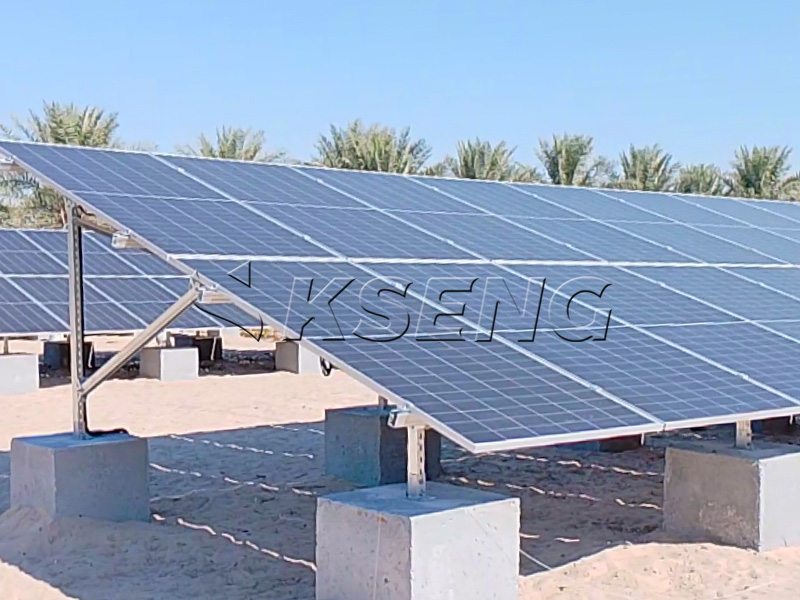
Concrete solar foundation is a traditional and widely used foundation type, which is divided into cast-in-place concrete foundation and precast concrete foundation. It is made by pouring concrete (usually C20-C30 grade) into pre-designed templates, and embedding anchor bolts to connect with solar brackets. The cast-in-place type is poured on-site, while the precast type is produced in the factory and transported to the site for installation, which is more efficient.
Core Advantages: It has excellent load-bearing capacity and stability, can withstand large wind and snow loads, and is suitable for various complex geological conditions. The service life is long (consistent with the solar system, up to 25-30 years), and the maintenance cost is extremely low. It is especially suitable for large-scale centralized solar power plants, where the stability requirements are high.
Disadvantages: The construction process is relatively complex, requiring on-site excavation, formwork erection, concrete pouring, and curing (the curing period is usually not less than 7 days, and 10 days in winter), which leads to a long construction cycle. The excavation work will disturb the surrounding environment, destroy vegetation, and generate a certain amount of construction waste. In addition, the material and labor costs are relatively high, and the transportation cost of concrete is also an important part of the project cost.
Applicable Scenarios: Centralized solar power plants, large commercial solar projects, sites with good soil bearing capacity (such as cohesive soil, sandy soil), and areas with high wind and snow loads. It is also suitable for projects with no strict requirements on the construction cycle and low environmental protection restrictions.
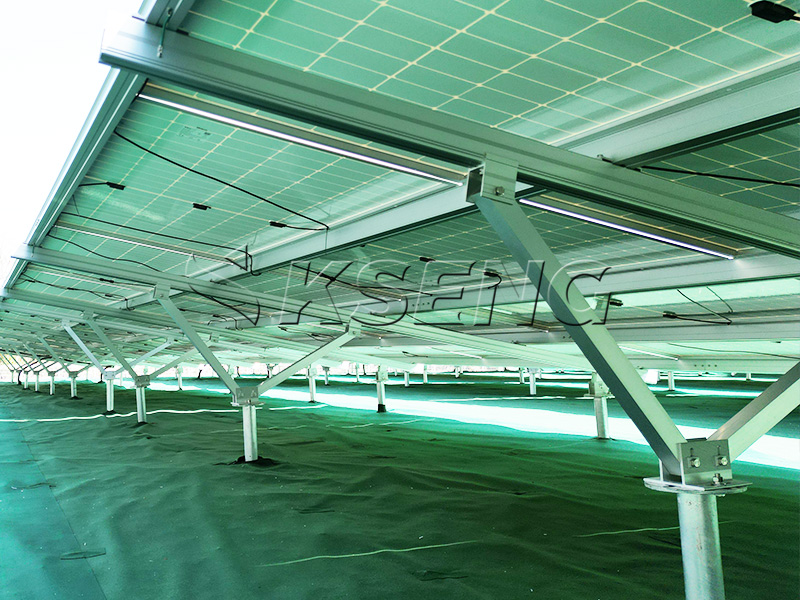
Screw pile solar foundation, also known as helical pile foundation, is a new type of foundation that has developed rapidly in recent years. It is composed of a steel pile body and helical blades. It is installed by rotating the pile body into the soil through a professional pile driver, without the need for excavation, concrete pouring, or curing. The pile body is usually made of galvanized steel (zinc layer thickness ≥86μm in saline-alkali areas) to improve corrosion resistance.
Core Advantages: The construction efficiency is extremely high—each pile can be installed in 15 minutes or less, which can greatly shorten the construction cycle and realize "pile driving and installation on the same day". It does not require excavation, so it has little impact on the surrounding environment, no construction waste, and is suitable for environmentally sensitive areas such as grasslands and wetlands. The installation process is simple, requiring only professional pile driving equipment, and the cost is lower than that of cast-in-place concrete foundation in many scenarios. It can also be recycled and reused, which is more environmentally friendly.
Disadvantages: The load-bearing capacity is greatly affected by the soil quality. It is not suitable for hard rock, thick gravel, or other geological conditions, because it is difficult to rotate and insert, and even the pile body may be damaged. In areas with strong corrosion (such as coastal saline-alkali areas), the steel pile body needs additional anti-corrosion treatment, otherwise, it will affect the service life. The initial equipment amortization cost is relatively high.
Applicable Scenarios: Distributed solar power plants, agricultural-solar complementary projects, fishery-solar complementary projects, areas with soft soil (such as silt, loess), environmentally sensitive areas (grasslands, wetlands), and projects with tight construction schedules. It is also suitable for projects where excavation is not convenient or prohibited.
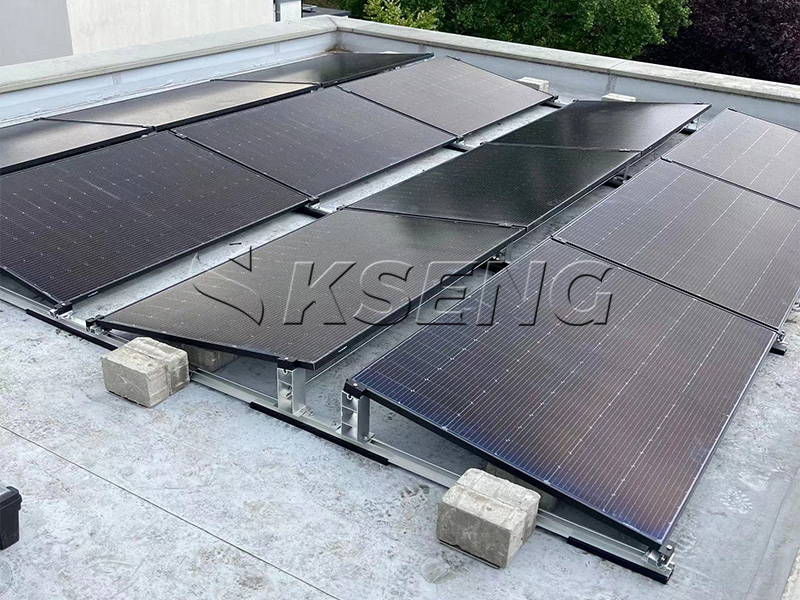
Ballast solar foundation, also known as weight-based foundation, is a non-penetrating foundation that does not need to be inserted into the soil. It relies on the self-weight of heavy materials (such as precast concrete blocks, steel weights, or even recycled materials) to fix the solar brackets, ensuring the stability of the solar system. It is usually prefabricated in the factory and installed on the ground or roof by hoisting.
Core Advantages: The construction is extremely simple, no excavation or pile driving is required, and the installation speed is fast. It does not damage the original ground or roof structure, so it is suitable for roof solar projects (flat roofs), temporary solar projects, and sites where ground penetration is prohibited (such as capped landfills). The cost is relatively low, especially for small-scale solar projects, and the later disassembly and relocation are convenient. It has almost no impact on the environment and does not disturb the soil or vegetation.
Disadvantages: The stability is relatively poor, and it relies entirely on self-weight to resist wind and uplift forces, so it is not suitable for areas with high wind loads. It requires a flat and hard installation surface; otherwise, it is easy to tilt or shift. For large-scale solar projects, a large number of weight materials are needed, which will increase the transportation and installation costs, and also occupy a large area. The anti-overturning capacity is weak, and it is not suitable for areas with heavy snowfall or uneven ground.
Applicable Scenarios: Roof solar projects (residential, commercial flat roofs), small-scale ground solar projects, temporary solar projects, sites where ground penetration is prohibited, and areas with low wind loads and flat terrain. It is also suitable for projects that need to be disassembled and relocated in the later stage.
2. Key Factors for Selecting Solar Foundations
To choose the most suitable solar foundation type, it is not enough to only understand the characteristics of each type. It is also necessary to comprehensively consider the following key factors, which directly determine the rationality, economy, and safety of the foundation selection. These factors are also the core points that users often search for, which can improve the relevance of the article.
2.1 Geological Conditions
Geological conditions are the primary factor determining the type of solar foundation. First, it is necessary to conduct on-site geological surveys to understand the soil type, bearing capacity, underground water level, and whether there are hard rock layers or thick gravel layers. For example, if the soil bearing capacity is good (≥150kPa), concrete foundation or screw pile foundation can be selected; if the soil is soft (such as silt), screw pile foundation is more suitable (it can penetrate the soft soil layer to reach the stable soil layer below); if the site is hard rock, cast-in-place concrete foundation (fixed by embedding in rock) is more suitable; if the underground water level is high, screw pile foundation or precast concrete foundation should be selected to avoid the impact of water on concrete curing.
2.2 Project Scale and Type
Large-scale centralized solar power plants have high requirements for stability and load-bearing capacity, so concrete foundation is usually the first choice; distributed solar power plants (residential, commercial) have small scale, high requirements for construction efficiency and environmental protection, so screw pile foundation or ballast foundation is more suitable. Roof solar projects can only choose ballast foundation (non-penetrating) to avoid damaging the roof structure; agricultural-solar and fishery-solar complementary projects require little impact on the land, so screw pile foundation is the best choice.
2.3 Construction Cycle and Efficiency
If the project has a tight construction schedule and needs to be put into operation quickly, screw pile foundation or ballast foundation should be selected, because their construction speed is far faster than that of concrete foundation (no curing period). If the construction cycle is not tight and the stability is the primary consideration, concrete foundation can be selected. For example, in some emergency solar power projects, screw pile foundation can shorten the construction period by 50% compared with concrete foundation.
2.4 Environmental Protection Requirements
In environmentally sensitive areas such as nature reserves, grasslands, and wetlands, excavation and construction are strictly restricted. At this time, screw pile foundation (no excavation) or ballast foundation (no ground damage) should be selected to minimize the impact on the ecological environment. Concrete foundation requires large-scale excavation, which will destroy vegetation and soil structure, so it is not suitable for such areas. In addition, screw pile foundation can be recycled, which is more in line with the concept of green development.
2.5 Cost Budget
Cost is an important factor for most projects. Generally speaking, the cost of ballast foundation is the lowest, followed by screw pile foundation, and concrete foundation is the highest. However, it should be noted that the cost is affected by the project scale, geological conditions, and regional labor costs. For example, in areas with high concrete transportation costs, screw pile foundation may be more economical; for large-scale projects, the cost of concrete foundation can be reduced through batch construction. In the 25-year operation cycle, although the initial investment of screw pile foundation is 22% higher than that of concrete foundation in some projects, the full investment return rate is 0.8 percentage points higher due to faster grid connection and reduced land leveling costs.
2.6 Climate Conditions
Climate conditions such as wind speed, snowfall, and temperature also affect the selection of foundations. In areas with high wind loads (such as coastal areas), concrete foundation or screw pile foundation with strong anti-uplift capacity should be selected; ballast foundation is not suitable because of its weak anti-wind capacity. In cold areas with permafrost, concrete foundation must be buried below the frost line (2.1 meters in Northeast China) and adopt trapezoidal section to prevent frost heave; screw pile foundation can avoid frost heave through deep anchoring, but the steel pile body needs to increase the wall thickness to resist low-temperature brittle fracture. In saline-alkali areas, concrete foundation needs to use slag Portland cement (sulfate resistance grade ≥KS90), and screw pile foundation needs to strengthen anti-corrosion treatment.
3. Practical Selection Guide
To help you quickly select the appropriate solar foundation type, we have sorted out a practical selection guide based on the above factors, which can be directly used in project practice:
Choose Concrete Foundation If: You are building a large-scale centralized solar power plant, the site has good soil bearing capacity, the construction cycle is not tight, the environmental protection requirements are not high, and long-term stability and low maintenance cost are required.
Choose Screw Pile Foundation If: You are building a distributed solar power plant, agricultural-solar/fishery-solar complementary project, the site has soft soil or environmentally sensitive areas, the construction schedule is tight, and you need to minimize environmental impact and realize rapid installation.
Choose Ballast Foundation If: You are building a roof solar project, small-scale temporary solar project, the site prohibits ground penetration, the terrain is flat, the wind load is low, and you need simple construction and low cost.
4. Common Mistakes to Avoid in Foundation Selection
In the actual project, many project owners make wrong choices due to insufficient understanding of the foundation types or ignoring key factors, which leads to unnecessary losses. Here are some common mistakes to avoid, which can improve the practical value of the article and attract more user clicks:
Mistake 1: Blindly pursuing low cost and choosing ballast foundation in high wind areas, which leads to the risk of solar panel overturning in strong winds.
Mistake 2: Ignoring geological surveys and choosing screw pile foundation in hard rock areas, which leads to difficult installation and increased costs.
Mistake 3: Overlooking the construction cycle and choosing concrete foundation for projects that need to be put into operation quickly, which leads to delayed grid connection and loss of power generation benefits.
Mistake 4: Ignoring environmental protection requirements and choosing concrete foundation in environmentally sensitive areas, which leads to failure to pass the environmental impact assessment.
5. Conclusion
The selection of solar foundation types (concrete, screw pile, ballast) is not a "one-size-fits-all" matter, but needs to be comprehensively considered based on geological conditions, project scale, construction cycle, environmental protection requirements, cost budget, and climate conditions. Each foundation type has its own advantages and applicable scenarios: concrete foundation is stable and durable, suitable for large-scale projects; screw pile foundation is efficient and environmentally friendly, suitable for distributed and environmentally sensitive projects; ballast foundation is simple and low-cost, suitable for roof and temporary projects.
By understanding the characteristics of each foundation type and following the selection guide in this article, you can choose the most suitable solar foundation for your project, ensure the long-term safe and stable operation of the solar system, optimize project costs and construction efficiency, and promote the sustainable development of the solar power industry. If you have more questions about solar foundation selection, you can contact our professional team for one-on-one consultation.